|
||
40. Net plessite |
| Listing of Structures |
| Back...Next |
| Meteorite - Cape York, IIIAB Iron. |
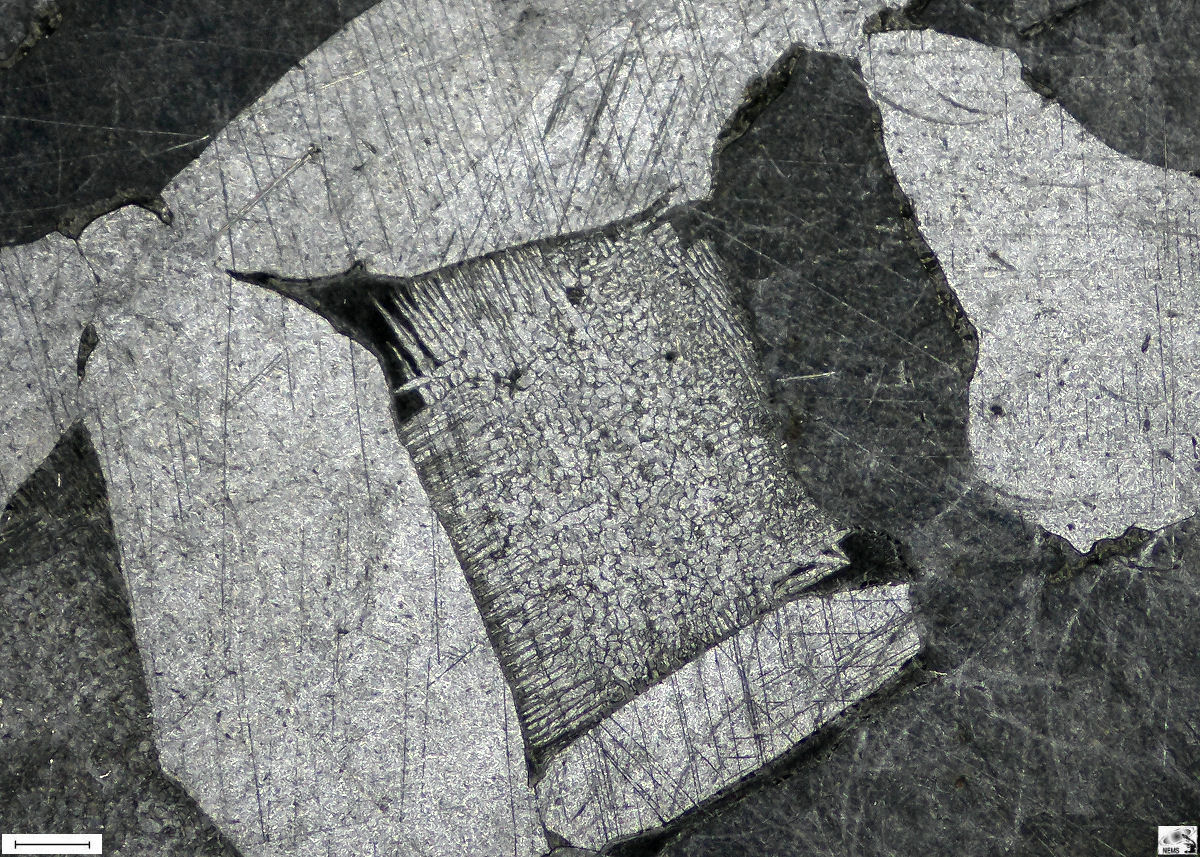
| Figure 1. Scale bar 500 µm. |
| Meteorite - Cape York, IIIAB Iron |
| Net plessite, Cape York. |
| Net Plessite Meteorite – Cape York, IIIAB Iron Net plessite is a secondary microstructure that develops within residual taenite regions of octahedrite iron meteorites during prolonged subsolidus cooling. In the Cape York IIIAB iron, these fields occupy the interstitial spaces between the coarser kamacite and taenite lamellae of the primary Widmanstätten pattern and display a characteristic open, net-like arrangement of fine kamacite and discrete taenite particles. The metallic Fe–Ni alloy of the parent body core begins as homogeneous taenite at high temperature. As the metal cools, kamacite nucleates and grows to form the familiar Widmanstätten architecture, leaving nickel-enriched residual taenite in the intervening spaces. With further cooling these residual fields transform into a fine intergrowth of kamacite and taenite. When the resulting taenite particles appear as a discontinuous network of roughly equant, micrometer-scale islands set in a continuous kamacite matrix, the texture is termed net plessite. The development of clear net plessite requires relatively slow cooling—slow enough for the primary Widmanstätten pattern to form fully and for the residual taenite to evolve into the observed fine network, yet not so slow that the particles coarsen or spheroidize extensively. Faster cooling tends to freeze finer, less resolved “black” plessite; slower cooling favors coarser duplex or pearlitic varieties. Several features of net plessite repay closer attention. The morphology grades continuously into comb plessite when the plane of section intersects elongated rather than equant taenite particles, revealing the three-dimensional connectivity of the residual network. Local variations in nickel content and the presence of minor phosphorus or carbon can shift the scale and clarity of the intergrowth, preserving a record of chemical heterogeneity within the original core. In many IIIAB specimens, including Cape York, the outer margins of net-plessite fields are bordered by ordered tetrataenite or cloudy-zone structures—products of still lower-temperature processes that further illuminate the terminal cooling history. Shock events, common in the dynamical evolution of iron-meteorite parent bodies, may partially reset or recrystallize these fields, generating secondary overprints that must be distinguished from the primary cooling texture. Thus net plessite is more than a descriptive term. It is a petrographic archive of the protracted thermal history of a differentiated planetesimal core, capturing the transition from the growth of the Widmanstätten pattern through the formation of fine residual intergrowths under the slow cooling conditions that characterized the IIIAB parent body. |
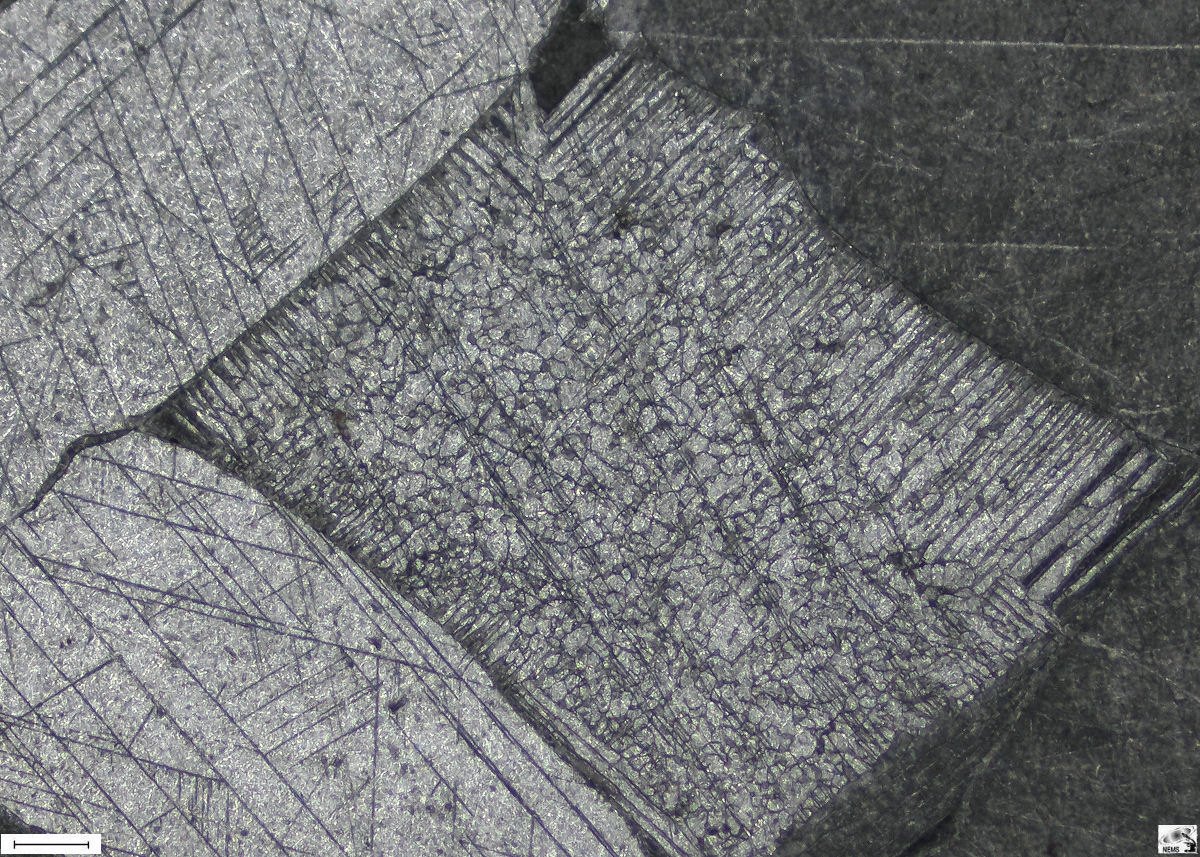
| Figure 2. Scale bar 300 µm. |
| Meteorite - Cape York, IIIAB Iron |
| Net plessite, Cape York. |
| References •Buchwald, V. F. (1975). Handbook of Iron Meteorites. University of California Press. •Goldstein, J. I., & Michael, J. R. (2006). The formation of plessite in meteoritic metal. Meteoritics & Planetary Science, 41(4), 553–571. •Yang, J., & Goldstein, J. I. (2006). Metallographic cooling rates of the IIIAB iron meteorites. Geochimica et Cosmochimica Acta, 70(12), 3197–3215. •Yang, J., Goldstein, J. I., & Scott, E. R. D. (2010). Main-group pallasites: Thermal history, and the nature of their parent bodies. Geochimica et Cosmochimica Acta, 74(15), 4471–4492. •Zhang, J., Williams, D. B., & Goldstein, J. I. (1993). The microstructure and formation of duplex and black plessite in iron meteorites. Geochimica et Cosmochimica Acta, 57(15), 3725–3735. |
| Listing of Structures |